Good product photography for ecommerce needs three things: consistent lighting, a clean background, and enough detail for a buyer to trust what they are seeing. A basic home studio setup costs roughly $100 to $500 and handles catalog shots well. The expensive gap is lifestyle photography, putting your product in a real scene with a real person, which runs $200 to $500 per image at a studio. AI closes that gap, so you can get the catalog shot and the lifestyle shot at a fraction of the cost, in hours instead of weeks. This guide covers the full setup, the real costs, and where AI fits.
What does product photography for ecommerce need to include?
A listing is not one photo. It is a small set that answers every question a shopper has before they buy, and missing one of them costs you the sale.
Every product needs a clean main image, usually on pure white, that isolates the item and meets marketplace rules. Then come the supporting shots: two or three angles so the buyer can see the whole product, a detail shot for texture or material, and a scale shot so they understand the size. Finally, a lifestyle image showing the product in use or in context, which is the one that does the most work on social and on the product page, because it lets the shopper picture owning it.
The first group is straightforward to produce at home. The lifestyle group is where cost and effort spike, because it often needs a model, a location, and styling. That split, easy catalog shots and expensive lifestyle shots, is the through-line of everything below.

What equipment do you need for product photography on a budget?
Less than most guides suggest. For catalog photography you can get clean, sellable images for under $200 if you buy the right things and skip the rest.
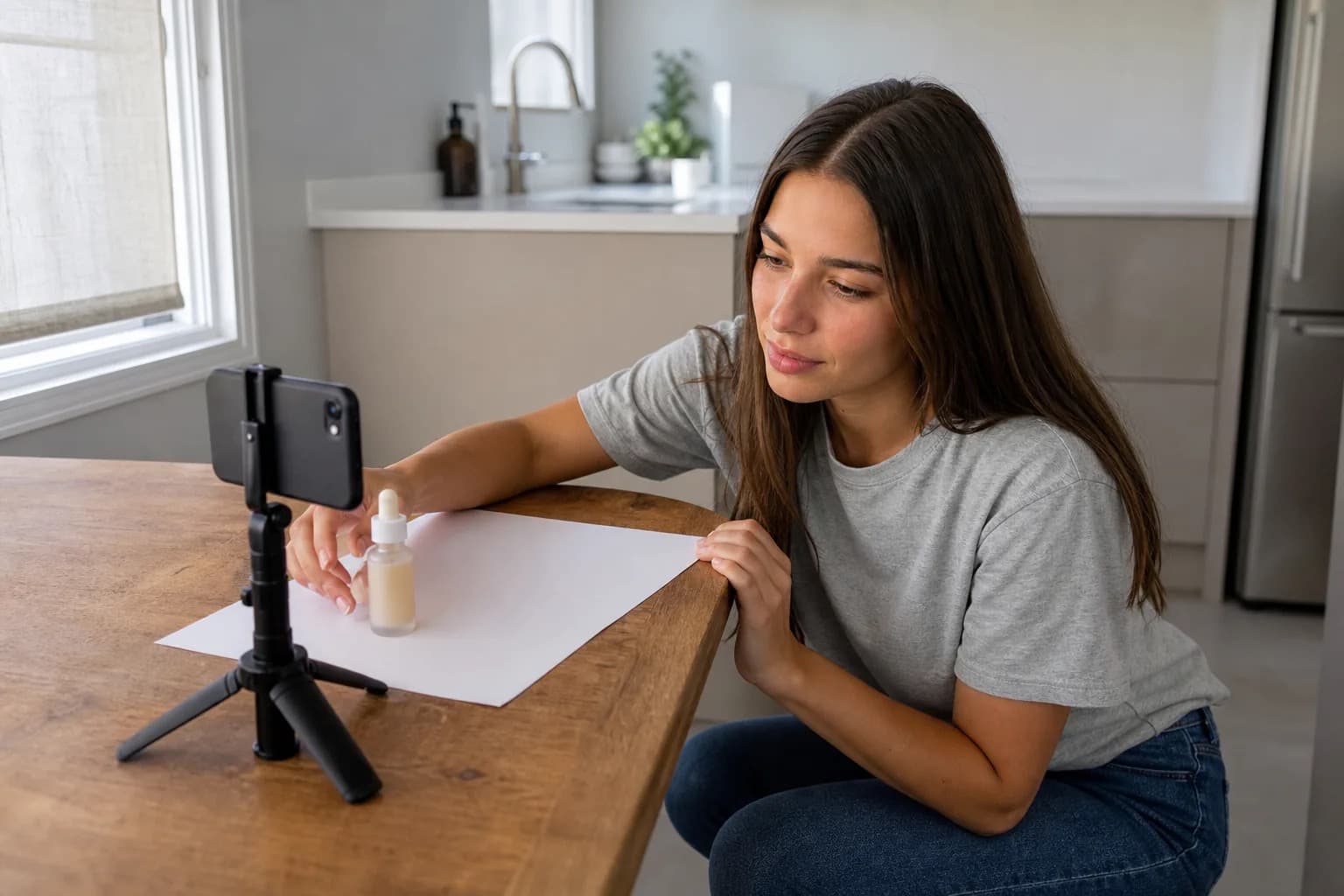
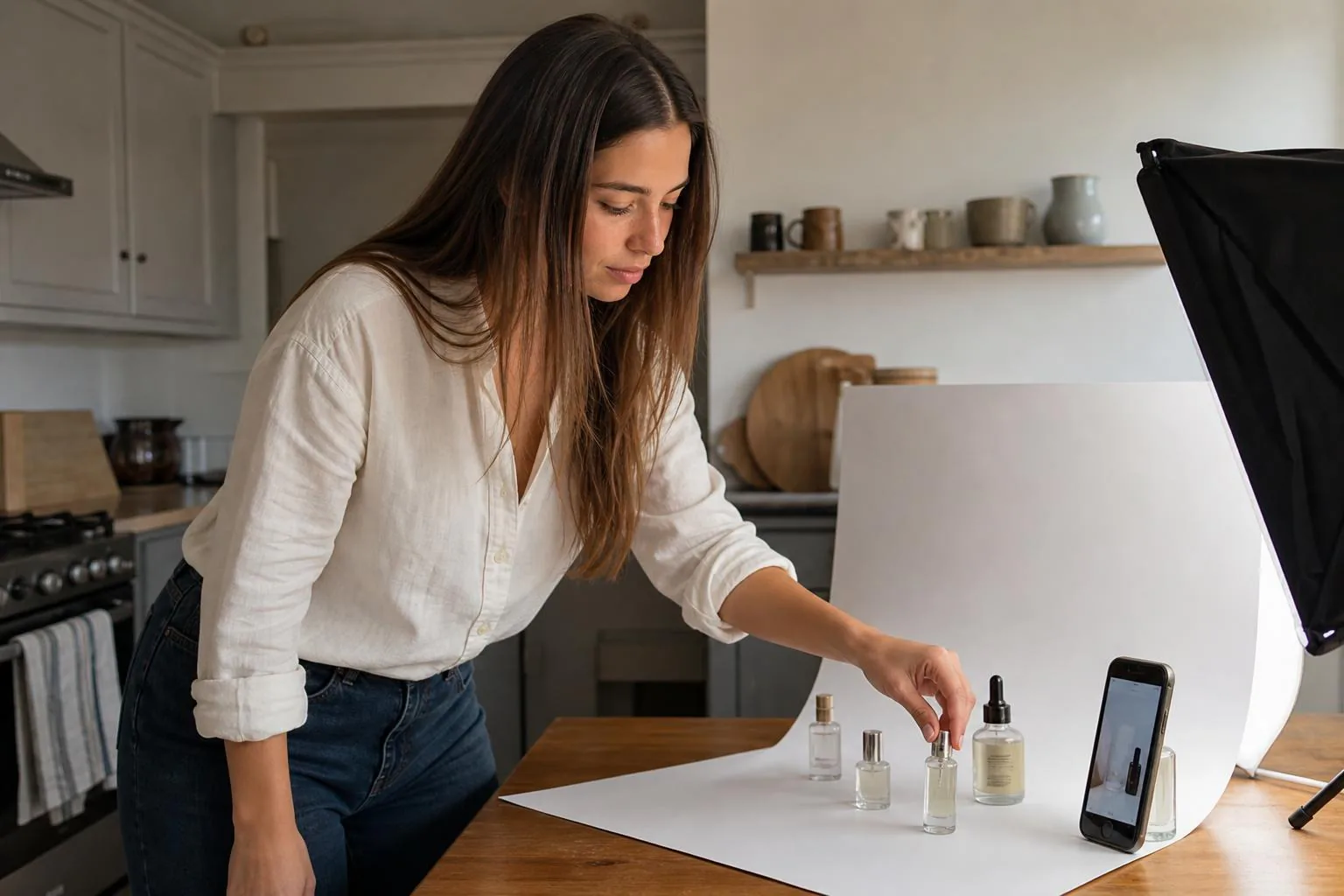
The short list is a tripod, a light source, and a clean backdrop. A tripod keeps every shot sharp and consistent, which matters more than the camera. For light, soft natural daylight from a window is free and excellent; a basic two-light kit or a single softbox covers you when daylight is unreliable. A white sweep, either a roll of paper or an inexpensive lightbox for small items, gives you the clean background marketplaces want. The camera itself can be a current smartphone for most products.
Skip the expensive camera body until you have a reason for it. Reflective, transparent, or small products eventually justify better gear, but a brand starting out gets more return from good light and a steady tripod than from a pricey sensor.

How do you set up lighting for ecommerce product photography at home?
Lighting is the single biggest difference between an amateur shot and a professional one, and it is mostly about softness and consistency rather than power.
Start with one main light at roughly 45 degrees to the product, diffused through a softbox or a sheer white sheet so the shadows are soft instead of hard. Add a second light or a simple white reflector on the opposite side to lift the shadows and even out the exposure. The goal is flat, neutral light with no harsh highlights, especially for catalog shots where the product has to look exactly like itself.
Two rules keep a whole catalog consistent. Lock your settings, the same light positions, white balance, and exposure for every product in a set, so the shots match. And shoot against the same background at the same distance each time. Consistency across a catalog reads as a professional brand; a set of mismatched lighting reads as amateur, even when each individual photo is fine.

How much does professional ecommerce product photography cost?
More than most small brands expect, especially for lifestyle work. Standard studio product photography runs roughly $25 to $150 per image, with simple white-background shots at the low end, around $45 to $65, and styled lifestyle images at the high end, typically $200 to $500 per final image depending on complexity (Squareshot, 2025).
The quoted rate is not the real cost. Once you add retouching, studio rental, product shipping, and coordination, the effective cost often runs close to double the headline figure, and rush turnaround adds another 10 to 30 percent (Squareshot, 2025). For a catalog of any size, that adds up fast, and every new variation, a new color, a seasonal scene, a different angle, means paying again.
This is why the cost question usually splits a brand into two strategies. Catalog shots are cheap enough to do in-house with the setup above. Lifestyle shots are where the budget goes, and where it is worth asking whether you need a studio at all.
How does AI product photography compare to a traditional shoot?
AI wins on cost, speed, and volume. A studio wins on guaranteed accuracy and on the hard product categories. Most brands end up using both rather than one or the other.
Traditional studio shoot vs. AI product photography
| Factor | Traditional studio shoot | AI product photography |
|---|---|---|
| Cost per image | $25 to $500, often double after extras | Roughly $1 to $2 |
| Turnaround | Days to weeks, plus shipping | Minutes |
| Volume and variations | Limited by studio time and budget | Hundreds of variations on demand |
| Catalog shots on simple products | Excellent | Excellent |
| Reflective, transparent, fine-detail items | Reliable, the studio advantage | Unreliable, can warp or invent detail |
| Lifestyle scenes with a model | New casting and shoot each time | Held by a consistent model layer |
Be honest about the limits before you switch anything. Image models struggle with mirrored and glass surfaces, with products made of many small parts, and with printed text or logos, where they can warp a reflection or invent a detail that is not on the real item. For those categories a real photo is still the safe call. For the rest, the cost and speed gap is wide enough that AI handles the bulk of the catalog and the camera covers the exceptions. One thing to watch: AI tools default to an over-polished, cinematic lighting that reads as fake on a feed and can make product shots look staged. Why AI photos look fake and what actually fixes it applies to product imagery as much as to portrait work. For a detailed walkthrough of the AI workflow and tool options, the AI product photography guide for ecommerce covers setup, prompting, and marketplace rules in full. If you sell on Amazon specifically, the Amazon product photography requirements and workflow covers the main-image spec and the secondary lifestyle rules in detail.

Which approach gives you consistent product photos across your whole catalog?
Consistency is the part that separates a coherent store from a pile of unrelated images, and it is the hardest thing to hold across a large catalog. Whether you shoot in-house or generate, the same product has to look like itself in every shot, and any lifestyle model has to be the same person across the line.
In a studio, consistency means locking your setup and rebooking the same model, which gets expensive the moment your catalog grows or you want seasonal refreshes. This is the gap AI closes best, because it can hold one model fixed across every product instead of a new casting per shoot. For apparel and anything worn or held, where one recognizable model should appear across the whole range, the guide on building an AI model for a clothing brand walks through the on-model approach.
The model step is the one most brands skip and the one that makes a catalog look like a real brand. Cladegrove holds one consistent model across your whole catalog, so the same person can wear, hold, or use every product without a new shoot for each one. Pair that with your in-house catalog shots, and you cover both halves of the listing: the accurate product image and the lifestyle scene that sells it.
Common questions
What camera is best for ecommerce product photography?
The one you already have, in most cases. A modern smartphone shoots more than enough resolution for a marketplace listing, and a mid-range mirrorless camera only pulls ahead on fine detail and low light. Spend on lighting and a tripod before you spend on a camera body, because steady, even light improves a product shot more than megapixels do.
How many product photos do you need per listing?
Plan for five to eight. A clean main image on white, two or three angles, a detail or scale shot, and at least one lifestyle image showing the product in use. Marketplaces reward listings with more quality images, and shoppers convert better when they can see the product from every side before buying.
Can you do ecommerce product photography with a smartphone?
Yes, and many small brands do. A current phone, a tripod, soft daylight or a cheap light kit, and a clean backdrop will produce listing-quality catalog shots. The phone falls short on lifestyle scenes that need a model or a styled location, which is where a studio or AI fills the gap.
Is AI product photography good enough for Shopify and Amazon?
For lifestyle and social images, yes, and brands already use it widely. For a marketplace main image it depends on the product and the platform. Simple goods on a plain background hold up well; reflective or detail-critical items still need a careful eye or a real photo. Check the current marketplace policy before you publish, since some require disclosure of AI-generated images.
What is the best background for product photography?
Pure white is the standard for catalog and marketplace main images, because it isolates the product and meets most platform requirements. For lifestyle shots, a real or styled scene that fits the product context converts better. Many brands shoot on white for the listing and use a scene for the gallery and ads.