
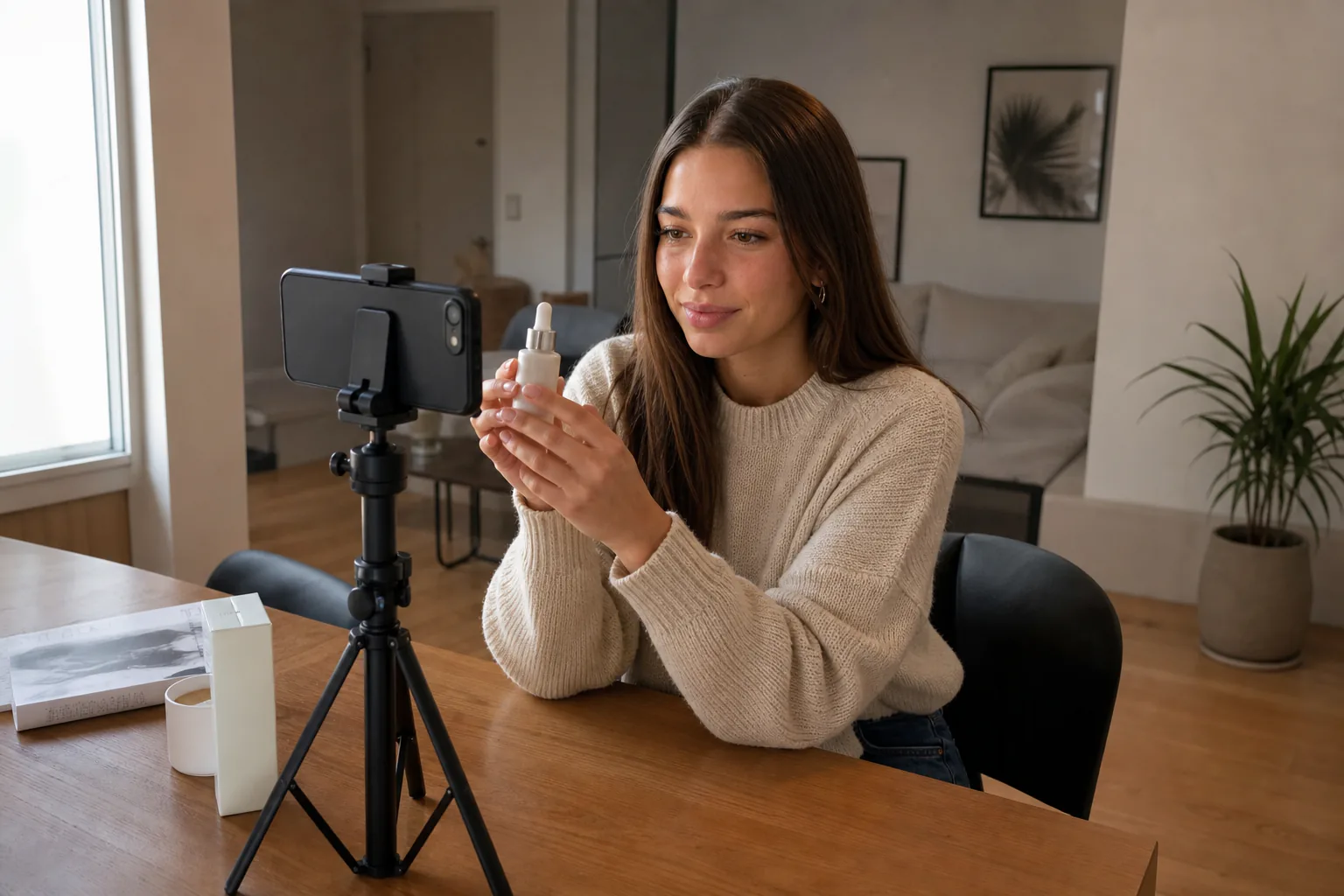
A UGC creator makes brand-ready content, things like product demos, reviews, unboxings, and lifestyle clips, that companies use in their own ads and social channels. One difference from an influencer changes the whole model: brands pay you for the content itself, not for your follower count. You film the video; the brand posts it on their account. You can have zero followers and still get paid, which is why this is the most accessible paid creator path right now.
What is a UGC creator, exactly?
UGC stands for user-generated content, and a UGC creator is someone who produces that content on commission for brands. You are hired to make a short video or a set of photos that look like a real customer made them: authentic, phone-shot, native to the feed. The brand then runs that content as an ad or organic post on its own channels. You are a content supplier, not the publisher.
This is a real job category, not a side hobby with a label. Brands moved budget toward UGC because polished studio ads stopped performing as well as content that looks like a genuine recommendation from a normal person. That shift created steady demand for creators who can produce that authentic look on a schedule, which is a production skill more than a fame one.
The mental model that helps: a traditional influencer sells access to their audience, while a UGC creator sells a service. One rents you attention; the other hands you a deliverable you own and distribute. That distinction drives everything else, from how you get paid to whether your follower count matters, which it mostly does not.

UGC creator vs influencer: what is the actual difference?
The clearest way to see it is to ask where the content gets published and who the audience belongs to. An influencer posts on their own account, to their own followers, and the brand pays for that reach. A UGC creator hands the content to the brand, which posts it to the brand's audience, and gets paid for the content as a product. Same video format, opposite business model.
That difference cascades into the practical details. An influencer's price scales with follower count, so the barrier to entry is building an audience first. A UGC creator's price scales with content quality and output, so a beginner with no audience can charge from day one. An influencer manages a public personal brand; a UGC creator can stay anonymous, work behind the scenes, and never grow a following at all.
The two roles overlap when a brand wants both reach and content, but the pricing and the path stay distinct. For someone deciding which to pursue, the honest read is that UGC is the faster route to paid work because it removes the audience-building wait, while influencing is the route if you want to be the public face. Many creators start with UGC for income and build an audience on the side. The broader landscape of building a brand presence without going on camera is covered in the guide to faceless digital marketing, which applies the same no-face principle across platforms and formats.

How much do UGC creators charge?
UGC pricing is per video, and the 2026 range runs roughly $100 to $500 and up per single video, with the average landing between $150 and $212 and a median around $175 (UGCJobs and Influee pricing data, 2026). The spread is wide because experience, niche, and editing complexity all move the number.
By experience level, the bands are fairly consistent across rate guides. Beginners charge $75 to $300 per video, mid-tier creators $300 to $1,000, and professional or top-tier creators $500 to $1,200, with the most established starting their pricing at $500 to $800 per deliverable (2026 rate guides). Short-form formats for TikTok and Instagram Reels often command more because of the editing time and the performance value to the brand.
Two extras matter as much as the base rate. Bundles: many creators discount packages of five or more videos by around 19%, so a $200 video might sell at roughly $810 for five instead of $1,000. Usage rights: when a brand wants to run your content as paid ads, the standard is to charge 50% to 100% of the base creation fee for a year of usage, billed on top of the production cost. Translated to monthly income, a part-time creator landing a handful of deliverables a month can realistically reach four figures, while full-time creators with retainers and usage fees clear more. Treat those as estimates that depend on volume and niche, not guarantees.

How to become a UGC creator step by step
The path is short, and none of it requires an audience.
- Pick a niche. Choose one category you understand, such as beauty, home, food, tech, or wellness. Brands hire creators who clearly fit their product, so a focused niche reads as a safer bet than a generalist.
- Build a small portfolio. Make three to five sample videos for products you already own. These are your proof of style, and they are the single thing that lands the first paid deal.
- Set up where brands look. A simple page or profile on a UGC marketplace, plus a content-style social account, gives brands somewhere to evaluate you.
- Pitch and apply. Reach out to brands directly and apply through UGC platforms. Volume matters early; the first deal is the hardest, and it gets easier once you have paid work to show.
- Deliver, then systematize. Hit the brief, deliver on time, and turn your setup into a repeatable process so you can take on more deliverables without burning out.
The tools you use shape how fast you can produce. For the current stack, the best AI tools for content creators covers what speeds up filming, editing, and ideation without inflating the budget.

Do you need a big following to be a UGC creator?
No, and that catches people off guard. UGC pays for content, not reach, so a creator with 50 followers and a strong portfolio can out-earn an influencer with 50,000 who cannot produce on brief. Brands evaluate your sample videos, your style, and your reliability. Your follower count is close to irrelevant to the decision.
This is exactly why UGC is the accessible entry point into paid creator work. You skip the slowest, least certain part of the influencer path, the months or years of audience building, and go straight to the part that pays. What you trade is public visibility: nobody knows your name, because the content runs under the brand. For most people getting started, that trade is worth it, because the income arrives without the audience-building gamble.
What you do need is consistency of output and quality. A brand that hires you wants the same standard on video ten as on video one, and it wants you to deliver on schedule. That reliability is the real reputation in UGC, and it compounds: consistent delivery turns one-off clients into retainers.
Where do UGC creators find brand deals?
Three channels carry most of the work. UGC marketplaces and platforms match creators with brands actively looking to buy content, and they are the fastest place to land a first deal because the brands arrive ready to hire. Direct outreach, pitching brands you actually use, lands higher-value ongoing relationships but takes more effort per deal. And inbound, where brands find you through a content-style social account, grows slowly but becomes your best source once your samples are public.
The smart approach early is to run all three at once rather than wait for any one to pay off. Apply on platforms for volume, pitch directly for the relationships, and keep a public profile so brands can find you. The creators who fill their calendar treat outreach as a regular habit, not a one-time push, because UGC is a steady-demand service business, not a viral lottery.
One angle widens the field further: you do not have to show your face to do this. Hands-only demos, voiceover over B-roll, and AI-generated on-screen presenters all qualify as UGC, which opens the work to anyone who would rather stay off camera. Brands are increasingly commissioning this kind of AI-produced content directly, a practice known as AI UGC, where the content is generated rather than filmed but serves the same purpose in ads and social channels. If that is you, TikTok content ideas without showing your face and faceless YouTube channel ideas cover formats that carry straight into UGC work. The barrier used to be that a recurring on-screen face meant filming yourself; a consistent AI character removes that. Brands in fashion and apparel also use this approach for catalog imagery, which is a natural extension of UGC work: how clothing brands use an AI model across their catalog shows how the same character-consistency principle applies on the brand side. Cladegrove keeps one character identical across every shot, so you can build a recognizable faceless persona to front the content without ever being on camera. See how it keeps a creator's character consistent.

Common questions
What equipment does a UGC creator need to get started?
Less than most people assume. A recent smartphone, natural light or a basic ring light, a small tripod, and a clip-on microphone cover the essentials for filming. Free or low-cost editing apps handle the rest. Brands hiring UGC want content that feels native to a phone feed, so studio gear is rarely the thing that wins the deal.
Can you be a UGC creator without showing your face?
Yes. Plenty of UGC works without a face on camera: hands-only product demos, voiceover with B-roll, flat-lay styling, and screen recordings. Brands buy the content and the message, not your face. AI-generated content widens this further, letting you produce a consistent on-screen presenter without filming yourself at all.
What is a UGC creator portfolio and why do you need one?
A portfolio is a small set of sample videos that show a brand how you make content, even if you made them for products you bought yourself. It is the single thing that lands your first paid deal, because brands hire on demonstrated style, not follower count. Three to five strong samples in one niche beat a large but scattered collection.
How do UGC creators get paid (per video, per package, retainer)?
Most charge per deliverable, with a single video as the base unit. Many sell bundles of three to five videos at a small discount, and established creators move some clients onto monthly retainers for a set number of videos. Usage rights are billed on top, commonly 50% to 100% of the base fee for a year of paid ad use.