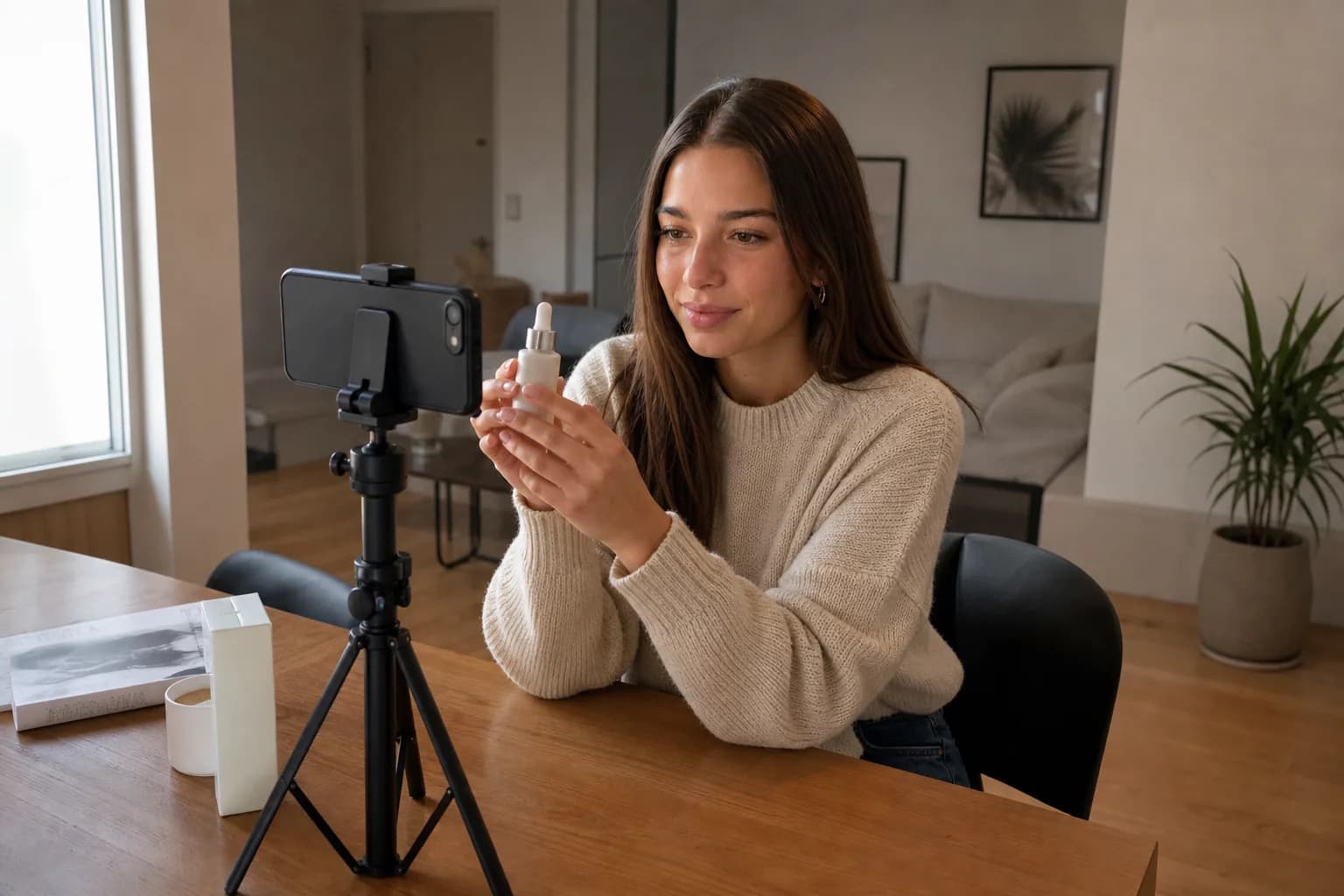
UGC creator jobs live in four places, and they are not equally open to beginners: dedicated UGC job boards where brands post briefs you apply to, creator marketplaces that match you to campaigns and set the rate, general freelance platforms where you set your own, and direct pitching to brands with no middleman. Almost all of them ask for one thing before any money moves. Not a follower count, not a client history: a portfolio of sample content that proves you can shoot a product and make it look worth buying.
Where do UGC creator jobs actually come from?
UGC creator jobs reach you through four channels, and it is worth knowing which one you are in, because each has a different gatekeeper.
UGC job boards. Brands and agencies post a brief, you apply. These are the closest thing the space has to a normal job listing, and boards like UGCJobs.com and UGC Job Board exist specifically to aggregate them. The gatekeeper is your application, so a weak or empty portfolio is what stops you here.
Creator marketplaces. You build a profile, the platform matches you to campaigns, the brand ships you the product, you shoot and deliver through the app. Billo, Insense, JoinBrands and Creator.co work this way. The rate is often set by the platform rather than by you: Billo pays creators in the $50 to $150 per video band, while Insense sits at roughly $75 to $200 for a 15 to 30 second video and $100 to $400 for a 60 second one (Collab Only, 2026 platform comparison). Lower ceiling, lower friction. That trade is the entire pitch of a marketplace.
Freelance platforms. Upwork and Fiverr have a large hidden UGC market inside them, listed under video editing, short-form content and product video rather than under "UGC". You set the price, which is why the range is wide, $50 to $500 and up on Upwork. The platform takes a cut (Fiverr 20%, Upwork a service fee in the 10 to 20 percent range) and the competition is global.
Direct pitching. You email or DM the brand yourself with sample content already attached. No fee, no platform cut, the highest rate per video, and the slowest path to a yes. Creators negotiating directly report $150 to $750 per video, well above platform-set pricing (Collab Only, 2026).

Beginners are usually told to start at the boards and marketplaces, and that advice is right, though not for the reason people give. The marketplaces are not better paid. They are better at handing you a brief, a product and a deadline, which is how you build the portfolio that unlocks everything else.
Can you get UGC creator jobs with no experience and no followers?
Yes, and the follower question is settled: the major platforms evaluate creators on content quality rather than audience size. Collab Only, Billo, Insense, Fiverr and Upwork all screen on the work, not the following (Collab Only, 2026). JoinBrands sets the bar the same way: you have to be 18 or over and living in a country it ships products to, and no follower minimum appears anywhere in the requirements.
This is the structural difference between UGC and influencer work, and it is why the category exists. An influencer sells you access to their audience. A UGC creator sells the brand a video the brand will run as an ad on its own channels, so your audience is irrelevant to the transaction. The full breakdown of the role, and how it differs from being an influencer, sits in what a UGC creator is and how to become one.
Experience is a softer gate. Nobody asks for a CV. They ask to see three to five pieces of content, and if the content is good, the absence of a client list is not fatal. Which moves the whole problem one step earlier.
What do brands and platforms want to see before they hire you?
A portfolio of finished, on-brief content. Three to five videos is the working minimum, and every one of them should look like an ad the brand could run tomorrow.
That means the samples need real production properties, not a phone shot in a dark kitchen. Clean lighting, a legible product, audio that does not clip, a hook in the first two seconds, and a recognisable format: unboxing, before and after, testimonial, problem-solution demo. Brands are scanning for competence, and they decide in about four seconds.
Here is the wall every beginner hits. To get hired you need a portfolio, and to build a portfolio you need products to shoot. Most people solve it by buying things they do not need or by filming whatever is on the shelf, which produces a portfolio of soap and protein powder that matches no brief anyone is posting. The samples do not have to come from a paying client, and they never did. They have to look like the work.
Spec work is legitimate and expected here. Pick five brands you would want to work with, study the ads they already run, and produce the content they would have briefed. That portfolio is on-target by construction, and it doubles as your pitch when you go direct.

How much do UGC creator jobs pay for a beginner?
A single UGC video averaged between $150 and $212 across the whole market in 2026, with the median sitting near $175 (Influee, 2026 UGC rates guide). Beginners start under that, around $100 a video, and the platform-set marketplaces are what hold them there.
Usage rights are the part beginners price at zero and should not. When a brand wants to run your video as a paid ad, that is a separate right from the content itself, and it adds 30% to 50% on top of the base rate depending on the term (Influee, 2026). Handing over perpetual, all-channel usage inside a $100 flat fee is the most common beginner mistake in the category, and it is invisible until you see the same video running as an ad a year later.
The arc those numbers describe: $50 to $200 a video on a marketplace while the portfolio is thin, the middle of the market once there are real deliverables behind you, and the $150 to $750 direct-pitch band when you stop going through a platform at all. Raise the rate after every five to ten completed jobs. Nobody will do it for you.

Can you do UGC work without showing your face on camera?
A large share of it, yes. Face-free UGC formats are standard: hands-only demos, flat-lay and tabletop, voiceover with b-roll, screen-and-product cutaways, ASMR unboxing. Brands buy these constantly, because the product is meant to be the subject of the shot.
What you give up is the testimonial category, where a person looking into the lens saying "this worked for me" is the whole asset, and that is the highest-trust format in the space. Which is a real ceiling if you never appear. The broader mechanics of building creator income without being on camera are covered in faceless digital marketing.

The other route around it is a consistent AI-generated presenter: one character, one face, appearing across everything you produce, so the work carries a recognisable person without that person being you. That only works if the identity is genuinely fixed, established once as a character rather than re-described for each new asset, which is where most attempts fall apart.
How long does it take to land the first paid brief?
Weeks rather than months, and the variable is not luck. It is whether the portfolio existed before the applications started.
The failure pattern is easy to describe: apply to forty briefs with an empty profile, get nothing, conclude the market is saturated, quit. The working pattern is to spend the first week producing five spec pieces, then apply to everything with a link attached. Boards, marketplaces and direct pitches at the same time, because they resolve on different timescales and only one of them needs to land.

Volume matters more than polish at the start. Ten applications a week with a decent portfolio beats one perfect application a month, and the tooling that keeps that volume sustainable is worth setting up early (the AI tools content creators actually use covers the production side).
The portfolio problem, and the shortcut around it
The gate is the portfolio, and the portfolio costs money and time you do not have yet. Products, a shooting space, decent light, and the willingness to be on camera in every frame.
Cladegrove takes the physical shoot out of the identity half of that. You design one creator persona, or upload a face you hold the rights to, dress it from a wardrobe you assemble, and every image after that shows the same person: the same face, the same styling, in a room that looks like a home rather than a set. It generates photographs rather than video, so what it covers is the still half of the output, the profile, the sample imagery a pitch needs, the stills a brief asks for next to the clip. No crew, no shelf of props, no obligation to put your own face in frame. See how it works.
Common questions
Are UGC job boards and platforms free for creators to join?
The main ones are. Collab Only, Billo, Insense, Fiverr and Upwork all let creators sign up for free, and they make their money on the brand side or on a cut of the deal (Collab Only, 2026 platform comparison). Treat a board that asks you to pay upfront for access to briefs as a red flag, because the paid-course industry around UGC is larger than the paid-work industry.
Do UGC platforms take a commission out of what the brand pays?
It depends on the model. Managed marketplaces like Billo and Insense set the price and pay you a fixed per-video rate, so the fee is invisible to you but built into what the brand is charged. Freelance platforms charge you directly instead: Fiverr takes 20% and Upwork takes a service fee in the 10 to 20 percent range (Collab Only, 2026). Direct-pitched work carries no fee at all, which is why experienced creators drift toward it.
Do UGC creator jobs work outside the US (UK, Europe, Canada)?
Yes, but the field narrows. Freelance platforms are global by design, so Upwork and Fiverr work from anywhere with a payout method. Product-shipping marketplaces are the constraint: a brand that has to mail you a physical product will filter by shipping region, which is why some briefs read "US-based creators only". Non-US creators tend to have better odds on software, apps and digital products, where nothing needs to arrive in the post.
Can the same piece of UGC be sold to more than one brand?
Not the same footage for competing brands, no. What you sell is content plus usage rights, and the usage terms decide what happens next. A limited licence (say six months of paid ads on one platform) means the brand cannot run it forever, and a perpetual, all-channel licence costs the brand more for that reason. Reselling a finished video to a second brand in the same category is the fastest way to lose both clients.