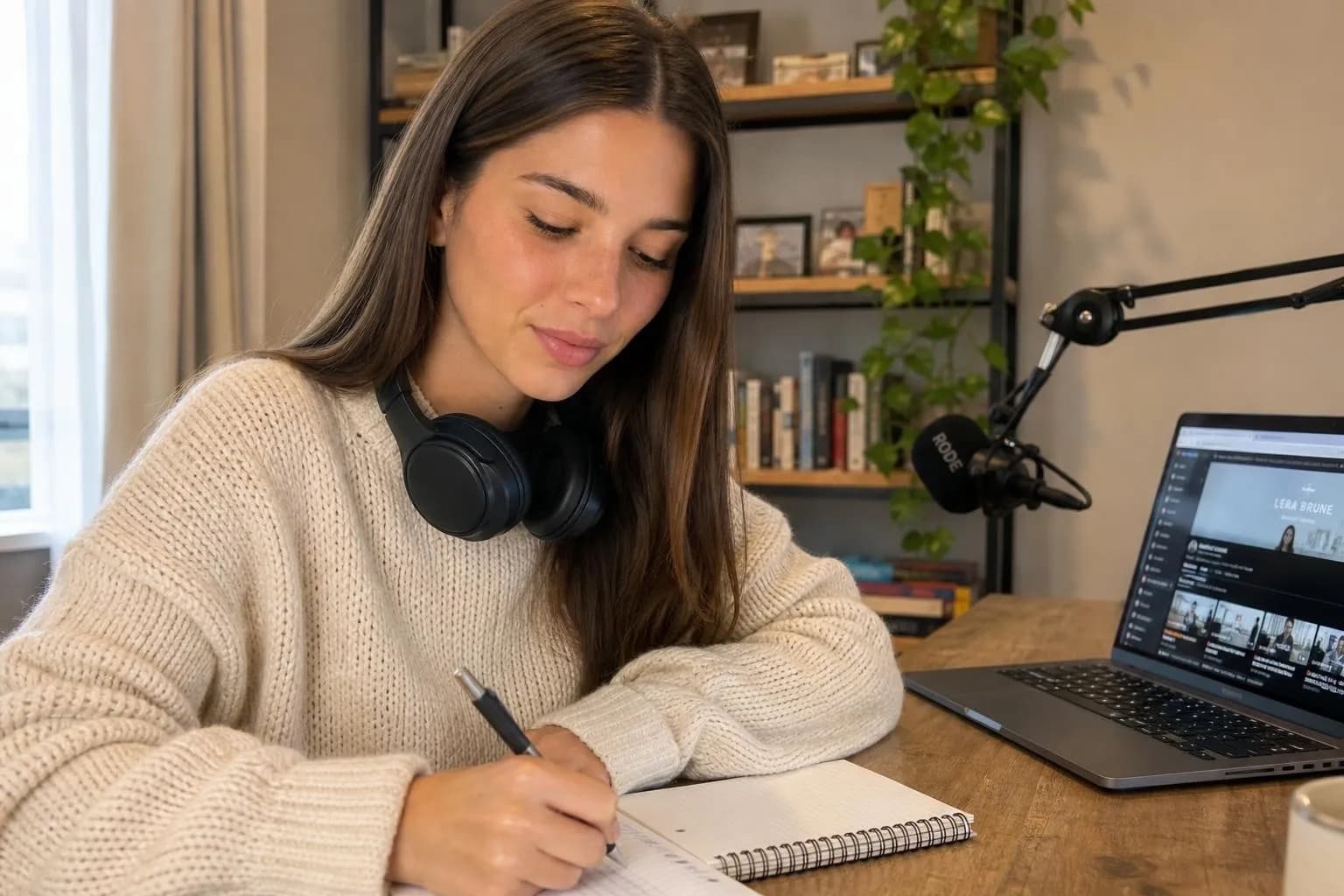

A faceless YouTube channel can earn real money, and the niche you pick matters more than your production quality. Advertisers pay the most to reach viewers in finance, business, and software, where a single converted customer is worth thousands, so those topics command the highest ad rates on the platform. These 25 faceless YouTube channel ideas are filtered for two things at once: how much advertisers pay against them, and whether you can produce them consistently without ever showing your face. If you want the full picture of how channels like these earn beyond YouTube, the honest guide to faceless digital marketing covers the whole model, and if your channel runs on a recurring AI host rather than your own face, how much AI influencers actually make is a useful benchmark for what that specific format can earn.
What makes a YouTube niche work without showing your face?
Three things. The value has to live in the information or the visuals, not in a personality the audience came to see. You need a repeatable format you can produce on a schedule without burning out. And for the channel to pay well, the topic has to attract advertisers who bid high for the audience.
Most faceless formats fall into a few buckets: screen recordings for tutorials, software, and finance dashboards; stock footage with voiceover for documentaries, explainers, and list videos; animation or slides for book summaries and education; and audio-led content like music and ASMR. None of them needs a camera pointed at you.
The trap is choosing a niche by how easy it is to produce rather than by what it earns. Relaxation music is trivial to make and pays almost nothing per view. A finance explainer takes real research and pays many times more. The sweet spot is a niche you can sustain that also sits where advertisers spend.

Which faceless YouTube niches pay the highest CPM in 2026?
CPM is what advertisers pay per thousand ad impressions, and it swings hard by topic. Finance leads by a wide margin. Personal finance and investing content carries CPMs in the $15 to $22 range, and the most commercial corners of it, credit card comparisons and investing, can reach $30 to $45 during the Q4 advertising peak (vidIQ, 2026). The economics are simple: a viewer who switches brokerage or credit card is worth thousands in lifetime value, so banks and fintech apps bid hard for that attention. The broader creator economy that funds these channels is projected to grow from $254.4 billion in 2025 to $313.95 billion in 2026 (Precedence Research, 2026).
Audience geography matters as much as topic. The same video earns three to five times more from viewers in the US, UK, Canada, and Australia than from tier-3 markets on identical content (vidIQ, 2026). A faceless finance channel aimed at a US audience can clear four figures in ad revenue from a six-figure monthly view count before a single sponsorship.
Here are 25 faceless niches, grouped by what advertisers pay against them and whether each one suits a recurring AI host.

25 faceless YouTube niches by US CPM tier and production format
| Niche | US CPM tier | Faceless format | Recurring AI host fit |
|---|---|---|---|
| Personal finance and investing | High | Charts and screen plus voiceover | Strong |
| Credit cards and banking explainers | High | Screen recordings and comparisons | Strong |
| Make money online and side hustles | High | Screen walkthroughs | Strong |
| Real estate and property analysis | High | Map and listing breakdowns | Strong |
| Business and company case studies | High | Stock footage and narration | Good |
| Digital marketing and SaaS tutorials | High | Screen capture | Strong |
| Insurance and money-law explainers | High | Slides and voiceover | Strong |
| Cryptocurrency analysis | High | Chart screens | Good |
| AI tools and software reviews | Mid-High | Screen capture | Strong |
| Tech reviews and explainers | Mid-High | Product B-roll and voiceover | Partial |
| Coding and developer tutorials | Mid | Screen recording | Strong |
| Career and job-skills coaching | Mid | Slides and a talking host | Strong |
| Health and wellness explainers | Mid | Stock footage and narration | Strong |
| Productivity and self-improvement | Mid | Animated text and voiceover | Strong |
| Language learning | Mid | Slides and a host | Strong |
| Science and space explainers | Mid | Stock footage and narration | Partial |
| History documentaries | Mid | Archival footage and narration | Partial |
| Book summaries | Mid | Animated slides | Good |
| Geography and data visualization | Mid | Maps and voiceover | Weak |
| True crime narration | Mid | Stock footage and narration | Partial |
| Gaming walkthroughs and guides | Low-Mid | Screen capture | Weak |
| Top 10 and list compilations | Low | Stock clips and voiceover | Partial |
| Motivation and quotes | Low | Stock footage and text | Partial |
| Relaxation, ambient, and study music | Low | Visual loops | Weak |
| ASMR and sleep content | Low | Audio and simple visuals | Weak |
What are the best faceless YouTube channel ideas for beginners?
If you are starting from zero, ignore CPM for a second and optimize for finishing your first ten videos. The beginner-friendly niches share two traits: a format you can batch, and source material you do not have to invent from scratch.
Book summaries, software tutorials, and list videos are the gentlest on-ramps. Each has a clear template you reuse every episode, which is what gets a beginner past the wall where most channels die: consistency. Productivity, career skills, and language learning are close behind, since the content is evergreen and the research is light.
The move that actually works is to start in a beginner-friendly format that also pays decently. A software or money-skills tutorial channel is far more sustainable than relaxation music, even though the music channel is easier to produce, because the tutorial channel earns enough per view to justify the hours. If you also want to build an audience on short-form while your YouTube channel grows, 30 faceless TikTok content ideas without showing your face covers the formats that carry the same approach to a short-video feed. For the toolkit that makes faceless production fast, see the best AI tools for content creators.

Which faceless niches work best with a consistent AI character host?
Most faceless channels rely on a voiceover over stock footage, which works but stays anonymous. A recurring on-screen host changes that, because viewers start to recognize and trust a face, and trust is what turns a one-time viewer into a subscriber. The catch used to be that an on-screen host meant showing your own face. A consistent AI character removes that trade.
The niches that gain the most from a recurring host are the ones where trust drives the watch: finance and investing, health and wellness, productivity coaching, career advice, and language learning. In those topics a familiar presenter who looks the same in every video reads as a real channel with a real person behind it. The niches that gain the least are the ones where the visuals are the point, like ambient music, gaming capture, or pure data visualization, where a host gets in the way.
Before you build the character, it helps to understand what an AI influencer actually is and how the business model works, because a YouTube AI host is essentially the same kind of persistent persona applied to long-form video. The hard part of an AI host has never been generating one good frame. It is keeping the same face across a hundred videos, so episode 80 looks like episode 1. This is the same structural problem ChatGPT users run into when generating a consistent character: the model has no memory of the last render, so each new image re-invents the face. If you are starting from zero and want to test the idea before paying for anything, what free AI influencer generators actually deliver is an honest look at where the free tier helps and where it runs out. That is the problem Cladegrove solves: it holds one character consistent across every shot, so your host stays recognizable for the life of the channel. For the full production setup, the guide on running a faceless YouTube channel with a consistent AI host walks through it end to end.

How do you pick a faceless YouTube niche you can actually stick with?
Pick the overlap of three things: what pays, what you can produce weekly, and what you will not hate after fifty videos. Most people get the first two right and ignore the third, then quit at video twelve.
Be honest about the work each niche demands. A finance channel pays the most and asks the most research per video. A list channel is fast to make but pays little and gets crowded. The right answer is rarely the highest-CPM niche on the list; it is the highest-CPM niche you can sustain. A mid-CPM channel that publishes weekly for a year beats a high-CPM channel that stops at episode eight.
Test before you commit. Make five videos in your top niche before you brand the channel around it. You will learn more about whether you can sustain it from making five than from any amount of planning, and you can still pivot cheaply at that stage.

Common questions
Can a faceless YouTube channel make money?
Yes, and many do. Faceless channels monetize the same way any channel does, through ad revenue, sponsorships, and affiliate links. A channel in a high-CPM niche like finance can out-earn a face-led channel in a low-CPM niche. What matters is the niche and the consistency, not whether your face is on screen.
Do faceless YouTube channels still work in 2026?
Yes. Faceless formats are still one of the most common ways to build a channel without being on camera, and AI production tools have made them faster to produce, not less viable. Competition is higher than it used to be, which is exactly why niche selection matters more now.
How many videos do you need before a faceless YouTube channel starts earning?
There is no fixed number, but you have to clear the monetization threshold first: 1,000 subscribers plus either 4,000 valid watch hours in the past 12 months or 10 million Shorts views in 90 days. Most channels need 20 to 50 solid videos before momentum builds. Consistency over months matters more than any single upload.
What equipment do you need to start a faceless YouTube channel?
Less than you think. A decent microphone for clear voiceover, screen-recording or editing software, and a source of visuals, whether that is screen capture, stock footage, or generated images. No camera, no lighting kit, no studio. That is the whole point of the format.
Is a faceless YouTube channel with AI considered authentic by viewers?
Viewers care about whether the content is useful and honest more than how it was produced. A faceless channel that delivers real value builds a real audience. Disclosing that a host is AI-generated, where the format makes that relevant, tends to earn more trust than hiding it.