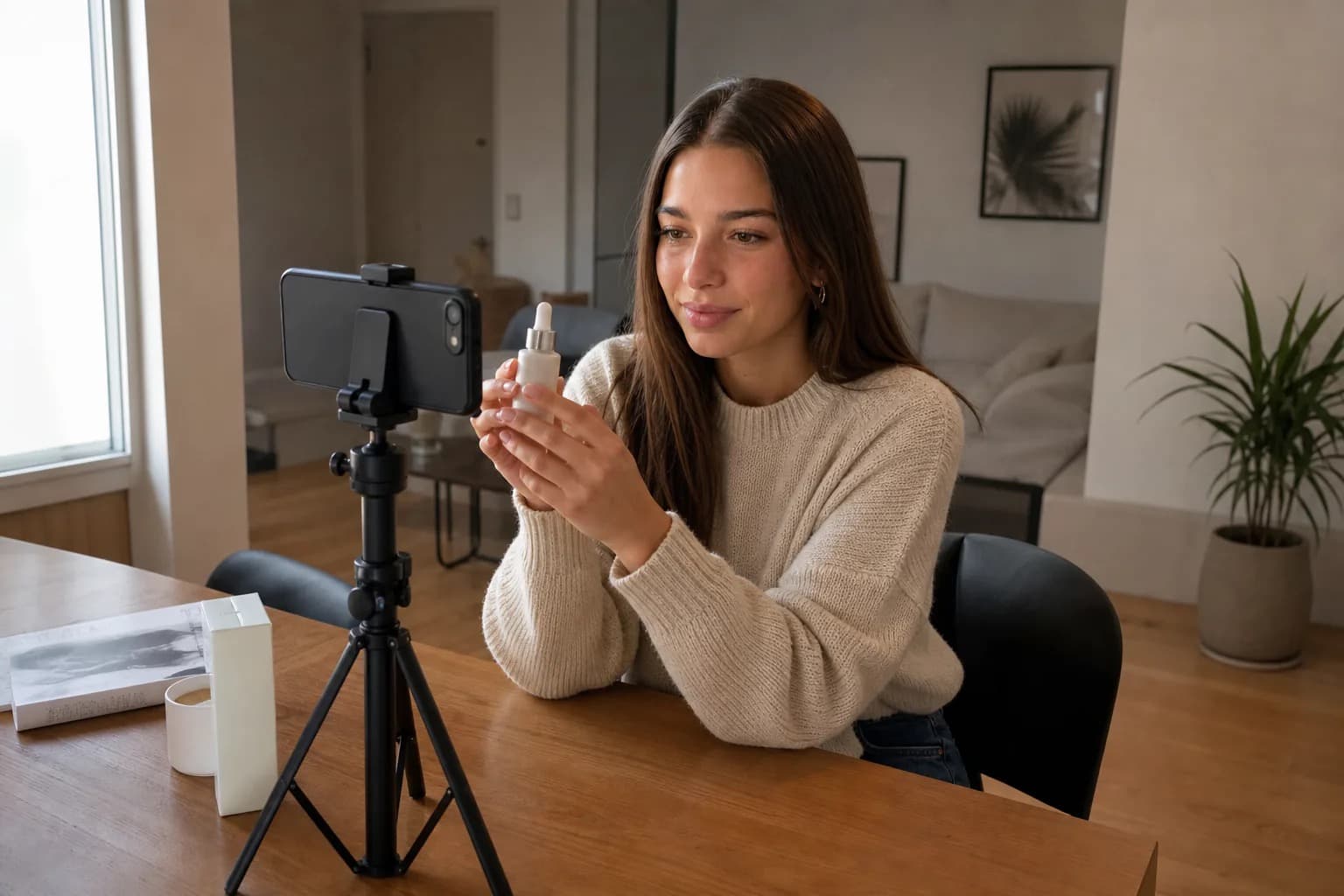
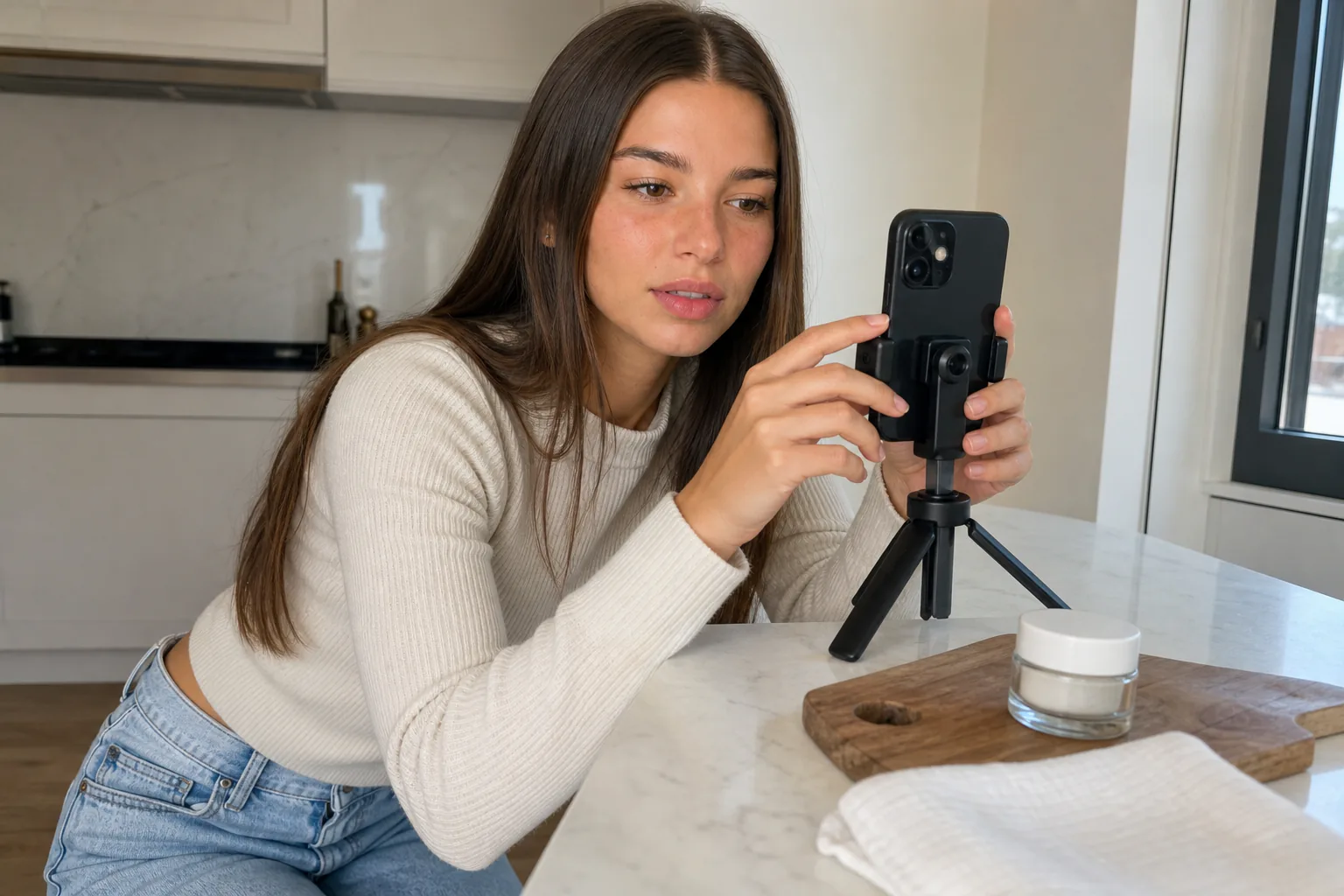
No, you do not need to be on camera to get hired. A faceless UGC portfolio works because the formats brands buy most often already have no face in them: hands-only demos, POV application shots, flat-lays and unboxings, voiceover over product B-roll, and screen recordings for apps. Brands paying for UGC want ad creative they can run themselves, and a face in the frame is optional in most product categories. The build is the same as any portfolio, with one extra option: when you do not own the product or the setting a piece needs, an AI character can carry the human element instead. Six to nine finished pieces on one page a brand can open on a phone is the entire deliverable, and most of the work is deciding what goes on it.
Does a faceless UGC portfolio actually work, or do brands want your face?
The confusion comes from mixing up two different products. Influencer marketing buys access to an audience, so the face is the point. UGC buys ad creative that the brand runs from its own accounts, so what matters is whether the video converts. Nobody watching a paid social ad is checking whether the creator is a known person.
Look at what actually runs in a performance ad account and the pattern is obvious. Hands opening a box, a countertop demo, a voice over a slow pan of the product, a phone screen with a thumb moving through an app. These are made faceless by default because they are cheaper to produce, easier to reshoot, and simpler to run in multiple markets when there is no recognizable person tying the ad to one region.

Where facelessness costs you work is a narrow band: apparel fit, anything where a reaction shot is the selling mechanism, and personal-brand deals where the brand is buying the creator rather than the video. That leaves most of the market open. The broader definition of the role, including what brands are buying when they hire one, is covered in what a UGC creator does.
What faceless content formats do brands hire for?
Six formats cover nearly everything a faceless creator gets asked for, and a portfolio is stronger with three or four done well than with all six done thinly.
Faceless UGC formats brands hire for
| Format | What it shows | Best for |
|---|---|---|
| Hands-only demo | Product used in real time, close crop from chest down | Kitchen, tools, beauty application, stationery |
| POV application | Camera at eye level, hands entering frame from the viewer point of view | Skincare, haircare, anything applied to the body |
| Flat-lay and unboxing | Overhead shot, packaging opened and laid out, hands moving items | Subscription boxes, gifting, multi-item sets |
| Voiceover over B-roll | Slow product footage cut to a spoken script | Any category, and the format most tolerant of imperfect footage |
| Screen recording | The product being used on a phone or desktop, narrated | Apps, software, marketplaces, online services |
| Text-on-screen narrative | Silent footage carrying a written hook and payoff | Sound-off feeds, and any script you would rather not read aloud |
Voiceover is the one worth learning first. A steady voice over ordinary footage outperforms shaky footage with no narration, and it is the format that makes the rest of the portfolio look intentional rather than shy.

How do you build a portfolio with no experience and no brand deals yet?
Every UGC portfolio starts unpaid. Brands are buying evidence that you can produce usable creative, not proof that someone paid you before, so spec work counts as long as it is honest about being spec.
Start with what is already in the house. Pick three or four products you use daily in categories that get advertised heavily, which usually means skincare, cleaning, kitchen, or an app on your phone. Write a real script for each one with a hook in the first two seconds, film it as though it were a paid brief, and label it as concept work on the portfolio page. Nobody penalizes spec work that is labeled. Passing spec work off as a client deliverable is what gets found out.
The gap that stops most beginners is the piece they cannot film: a product they do not own, a setting they do not have, or a category where the ad needs a person visible on camera and they have decided not to be. Three ways through it, in order of cost:
- Reshoot an existing ad concept with a product you do own in the same category. The skill is transferable and the brand can see it.
- Buy the cheapest item in the category you want to work in, and treat the cost as portfolio budget rather than shopping.
- Build the piece with an AI-generated character as the presenter, disclosed as AI on the portfolio page.
That third route is what makes a lifestyle or apparel-adjacent portfolio possible without a studio or a face. The character holds the product, uses it in a plausible room, and appears across several pieces as the same recognizable person, which is what separates a coherent body of work from a set of unrelated renders. It only holds together if the character stays identical between shots, which is the specific problem a consistent-character generator solves.

Whichever route you take, label it. A portfolio that says "concept, AI character" under a piece reads as competence. The same piece unlabeled reads as a problem when a brand asks to book the same shoot again.
Where should you host a faceless UGC portfolio?
Anywhere a brand can open on a phone in under three seconds without an account or a download. That rules out shared drive folders and anything behind a login, which is the most common reason a pitch goes unanswered.
Where to host a faceless UGC portfolio
| Host | Strength | Weakness |
|---|---|---|
| Notion page | Free, fast to build, easy to duplicate per pitch, videos embed inline | Looks the same as every other creator page, weak on mobile if the layout is column-heavy |
| Canva site | Visual control without design skills, decent on mobile | Video embeds are clumsier, slower to update |
| Own domain (site builder) | Signals a business rather than a side project, owns its own search results | Costs money, and takes time that would be better spent producing pieces |
| TikTok or Instagram portfolio account | Brands see the format in its native context, discoverable | No control over ordering, and no place for rates or usage terms |
Notion is the sensible default for a first portfolio, and the reason it appears in so many creator recommendations: a single page, a short intro, work grouped by format, and rates at the bottom. Duplicate the page per pitch and reorder the sections so the relevant category sits at the top, which takes a minute and reads as though the portfolio was built for that brand.

Whatever you pick, send one link that opens onto the work itself rather than a page of links to other pages. The brand contact opening it is triaging a list of creators and will not chase a second click.
What does a good faceless UGC portfolio look like?
Three structures that work, each sized for a different starting point.
The starter, six pieces, no client work yet
A one-line intro naming the categories you shoot. Two hands-only demos of products you own, in the same category, so the page reads as focused. Two voiceover-over-B-roll pieces on different products. One flat-lay. One screen recording if any of it is an app. Every piece labeled with the format and marked as concept work. Rates and turnaround at the bottom, with usage terms stated plainly, sized to what the market actually pays for your experience level and sales channel, broken down in full in UGC creator rates in 2026.
The category specialist, eight pieces, one niche
Everything in one vertical, for example home and kitchen. Three demos at different lengths, since brands cut for different placements. Two POV pieces. One unboxing. Two hook variants of the same script over the same footage, presented side by side, which shows a brand you understand testing rather than filming. This structure gets more replies than a broader page because it answers "can you shoot my category" before the question is asked.
The mixed portfolio with an AI character, nine pieces
Five pieces filmed with your own hands and products. Three built with an AI character presenting, each disclosed. One before-and-after strip showing the same product shot two ways. The disclosed pieces do a specific job here: they cover the categories your kitchen table cannot, and they show the same character across all three, which reads as a shoot rather than a coincidence.

In every version the top of the page is the strongest piece, not a biography. A brand contact decides in the first video whether to keep scrolling.
How do you make a faceless portfolio stand out instead of looking thin?
Thinness is rarely about the count. A page with six strong pieces in one category beats fifteen scattered across ten. What signals amateur is the absence of context around the work.

Four things that fix it, none of which require more filming:
- Write the brief above each piece, in one line: the product, the angle, and the placement it was cut for. That turns a video into evidence you can work from a brief.
- Show a hook variant, meaning the same footage with two different openings, labeled as such. Brands buy variation and almost no beginner portfolio demonstrates it.
- Put rates and usage terms on the page. Base rate, what usage is included, what an extension costs. Vagueness reads as inexperience and it costs you the brands who filter on budget.
- Keep the character consistent wherever there is one. If AI-generated pieces are on the page, the same face across all of them reads as a production. A different face in each one reads as a tool being tested.
Then get it in front of people. The portfolio is the asset the whole pitch runs on, and where to send it is a separate question covered in where UGC creator jobs are actually posted and in the platform-by-platform breakdown of where UGC creators apply and get paid.
The portfolio gap most faceless creators run into is the piece they cannot shoot, and it is a production problem rather than a talent one. Cladegrove keeps one character consistent across a whole set of pieces, so a portfolio can cover categories you do not own the props for, with the same presenter in every shot.
Common questions
What niches work best for faceless UGC?
Anything where the product does the work on camera: skincare and haircare, home and kitchen, pet supplies, stationery, supplements, tools, apps and software. These categories are built around close-up demonstration, so hands and product fill the frame naturally. Fashion and fitness are the hard ones, since the pitch usually depends on seeing the garment or the movement on a body.
Can faceless UGC creators charge the same rates as face-forward creators?
For content the brand runs as its own ad, yes, because the deliverable is a video rather than access to an audience. Rate guides put the median single-video rate at around $175, with most work landing between $100 and $500 depending on usage rights (Influee, 2026). The rate gap appears when a brand wants the creator to post from a personal account, which is a different product that faceless creators sell less often.
Do brands actually hire faceless UGC creators, or is it a hard sell?
They hire the format constantly without labeling it faceless. Hands-only demos, flat-lays, and voiceover-over-B-roll are standard in performance advertising because they are cheap to test and easy to localize. The sell gets hard only when a creator pitches faceless as an accommodation rather than as a deliverable the brand already buys.
How many pieces should be in a starter UGC portfolio?
Six to nine finished pieces across three or four formats is enough to get replies. Below six the page reads as an experiment, and above a dozen the weaker work drags the average down before anyone reaches the strong pieces. Add a piece only when it beats the weakest one already on the page, then remove that one.