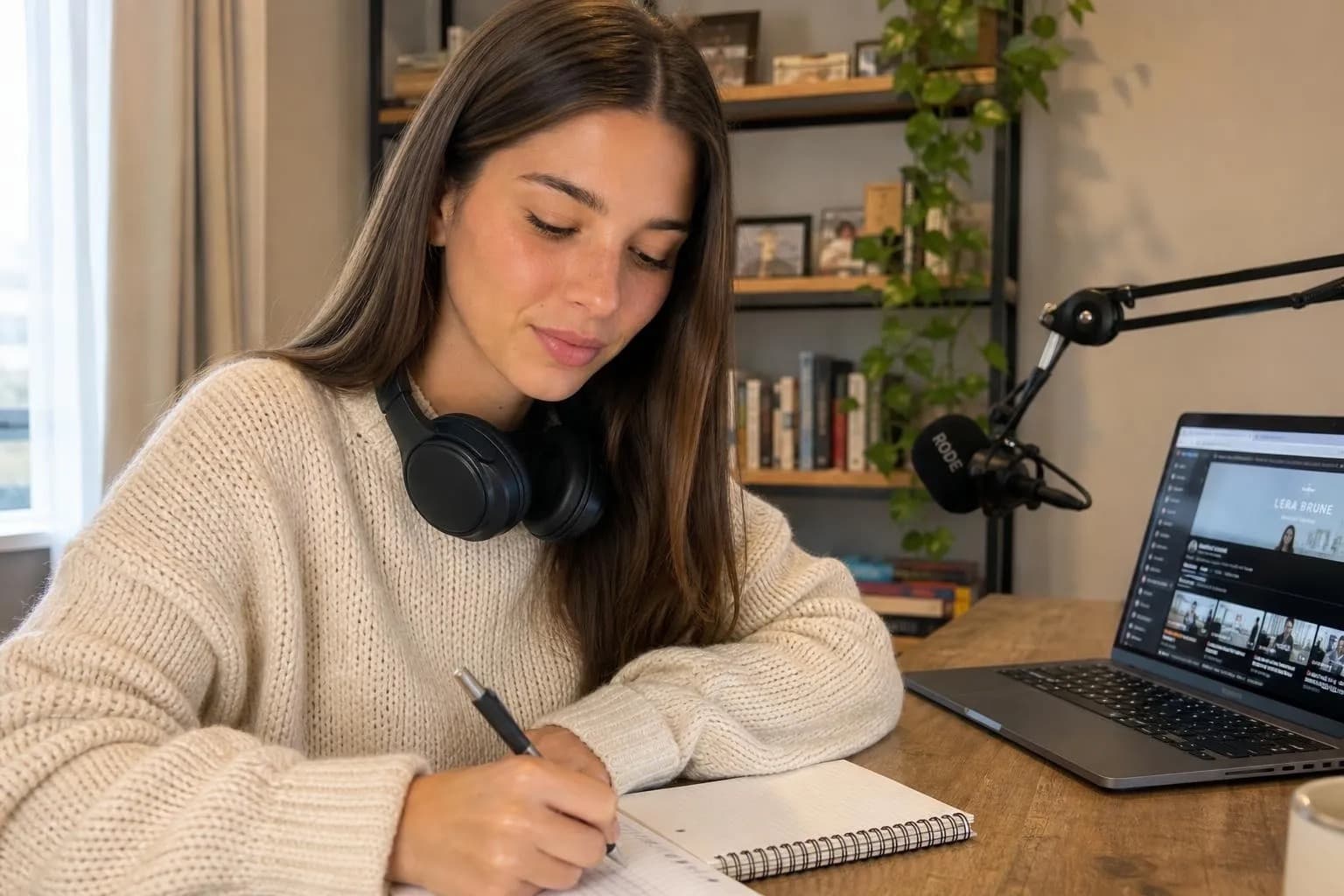

A faceless video is any video where the creator never shows their real face on camera. The frame carries something else instead: voiceover over b-roll, a screen recording, text and quote cards, a narrated news recap, an aesthetic compilation, or a consistent AI character acting as the on-screen host. Faceless videos work on every major platform, including YouTube, TikTok, Instagram, and Facebook, as long as the format matches what that platform's audience already watches, and in formats like tutorials, reviews, recaps, and compilations they hold attention as well as face-on-camera content does. The accounts that grow past their first few thousand followers tend to share one trait: something about the videos is recognizable from one upload to the next.
What counts as a faceless video?
A faceless video hides the creator's identity as the recurring visual anchor of the channel, not necessarily every human element. Hands in frame, a body from the shoulders down, a silhouette, and a voice are all standard in faceless content. What is absent is a face the audience learns to associate with the account.
That leaves four ways to fill the space where a presenter would normally be. Footage can carry the video, which is the voiceover-and-b-roll model. A screen can carry it, which covers tutorials, breakdowns, and software walkthroughs. Text and graphics can carry it, which covers quote cards, listicles, and data explainers. Or a character can carry it, meaning a consistent generated persona who appears on camera in the presenter's place.
The fourth option is newer than the other three and it is the one most format guides skip, because until recently keeping a generated character looking like the same person across fifty uploads was not realistic. It matters because it is the only faceless option that gives an account the thing a real face provides for free, which is instant recall in a crowded feed.
What faceless video formats actually get views?
Six format families account for most of what performs. Each one is a repeatable production system rather than a single idea, which is the point: a format you can run weekly beats a clever concept you can run once.
Voiceover over b-roll
The default faceless format. You write a script, record narration, and cut stock or self-shot footage underneath it. It suits explainers, listicles, history and true-crime recaps, product roundups, motivational and self-improvement content, and travel guides for places you have actually been.
The failure mode is generic stock footage with a synthetic voice reading a scraped article, which platforms are increasingly good at demoting and viewers are good at skipping. The fix is specificity in the script. Real numbers, sources you can name, an opinion you would defend. Twenty original seconds beat two minutes of assembled filler.
Screen recording and tutorials
Anything where the screen is the subject. Software walkthroughs, spreadsheet and formula tips, design and editing techniques, coding and no-code builds, AI tool demos, browser-based workflows, and settings-and-shortcuts content all live here.
This is the highest-trust faceless format because the proof is on screen. It is also the easiest to monetize, since the audience arrives with a problem and affiliate or product links answer it directly. Keep the recording tight, zoom in on the region that matters, and start with the outcome rather than the setup.

Text and quote cards
Static or lightly animated text over a background, cut to music or a voiceover. Daily quotes for a specific audience, book summaries, language learning, personal finance tips, study techniques, and short data explainers all work.
Production cost is close to zero, which is exactly why the ceiling is low and imitation is instant. Two things separate the accounts that grow here: a narrow audience definition, so the words feel written for someone, and a locked template system, so the grid is recognizable from a thumbnail.
News, recap, and commentary
A regular digest of what happened in a defined niche, delivered as voiceover plus screenshots, charts, or footage. Weekly roundups in a specific industry, sports and match recaps, market and crypto updates, gaming patch notes, and product launch breakdowns are the reliable versions.
Cadence is the whole product. A recap channel earns its audience by being the place that always posts on Monday, so pick a niche narrow enough that you can actually keep up. Timeliness also gives you a durable advantage over evergreen faceless content, since the supply of competitors willing to publish weekly is much smaller than the supply willing to publish once.

Aesthetic and satisfying compilations
Curated visual sequences cut to sound: interior and architecture tours, food preparation shot top-down, nature and travel footage, restoration and cleaning clips, art and craft process videos, car and watch detail shots.
These live or die on the first frame and the sound choice. They are the fastest faceless format to produce at volume and the hardest to build a brand on, because nothing in a compilation tells the viewer who made it. If you run this format, treat the edit itself as the identity: the same color grade and the same recurring opening beat on every clip, applied strictly.

A consistent AI character on camera
A generated person who hosts the videos, appearing across every upload the way a real presenter would: demonstrating a product, walking through a location, delivering the script to camera, modeling an outfit, or reacting to what is on screen.
This format inherits the strengths of a talking head without putting a real person on camera. It also carries the failure mode that sinks most attempts, which is drift: the character comes out slightly different every generation, and forty videos in there is no recognizable host, only forty strangers. The working pattern is to lock the character as stills first and animate from those frames, rather than generating every clip from a text prompt and hoping the face agrees with last week's. The full version of this setup for long-form is covered in running a faceless YouTube channel with a consistent AI host.

Which faceless formats fit TikTok, Instagram, and YouTube?
The formats above are portable, but each platform rewards a different subset. Match the format to the watch behavior rather than posting the same cut everywhere and hoping.
TikTok rewards the first two seconds and tolerates rough production. Screen recordings, hot-take recaps, and text-led hooks all travel well, and native captions do heavy lifting because a large share of viewing is sound-off. One structural detail worth planning around: TikTok's Creator Rewards Program only pays on videos longer than one minute, and requires 10,000 followers plus 100,000 views in the previous 30 days to apply (TikTok Creator Rewards Program terms, 2026). That pushes serious faceless accounts toward narrated and tutorial formats rather than seven-second clips. Platform-specific ideas are covered in TikTok content ideas without showing your face.
Instagram rewards saves and shares more than raw watch time, which favors formats a viewer wants to come back to: how-to Reels, carousel-style explainers cut as video, curated aesthetic clips, and before-and-after sequences. Reels share TikTok's aspect ratio and structure almost exactly, so the same asset usually reposts with minor edits. Consistency of look matters more here than on any other platform, because the grid is a shopfront and a visitor judges the whole account from six thumbnails, a point covered in more depth in 25 faceless Instagram account ideas.
YouTube rewards depth, and it is where faceless content has the clearest monetization path. Long-form tutorials, documentary-style narration, and recap series all reward the extra production time with better retention and higher ad rates. The Shorts route to monetization is real but steep: 1,000 subscribers plus 10 million valid public Shorts views in 90 days, against 1,000 subscribers plus 4,000 watch hours in 12 months for long-form (YouTube Help, 2026). For niche selection on this platform, see faceless YouTube channel ideas.
How do you stay recognizable across faceless videos without showing your real face?
Recognizability is the actual constraint in faceless content, and most creators discover it around upload thirty. The videos are fine, the retention is acceptable, and nobody can name the channel a good clip came from. Without a face, there is no default anchor, so the anchor has to be built deliberately.

Four levers do the work, and you need at least two of them.
- A locked visual treatment. One color grade, one caption font and position, one intro beat, one thumbnail structure. Applied strictly enough that a viewer identifies your video before reading the handle.
- A consistent voice. The same narration voice on every upload, with a recurring opening line. Voice is the cheapest identity signal in faceless video and the most frequently changed by accident.
- A narrow, stated territory. "Spreadsheet fixes for small business owners" is memorable in a way "productivity tips" never becomes. The topic itself carries recall when it is specific enough.
- A recurring on-screen character. The strongest of the four, because it gives the audience a person to recognize without exposing a real one. It also requires the character to actually hold. The same face and the same build in every scene, whatever the outfit or the location, or the lever works against you by making the channel look like it swaps hosts every week.
That last lever is where faceless production usually breaks down. General image and video tools treat every generation as unrelated, so the host's face shifts a little each time, and the drift is obvious once clips sit next to each other on a profile. A character who stays identical from one location and outfit to the next turns a faceless channel into a branded one, which is the difference between content that gets views and an account that gets followed.
Cladegrove holds one character identical across every generated still, which is the frame set a faceless channel builds and animates its on-screen host from. See how it works for creators.
Common questions
Can faceless content ideas work for affiliate marketing?
Yes, and faceless formats are well suited to it because affiliate content is about the product rather than the person. Screen-recorded software walkthroughs, comparison recaps, and top-five roundups all convert without a presenter, and the link lives in the bio or the description either way. The one thing that hurts affiliate performance is anonymity so complete that nobody trusts the recommendation, which is why a recurring voice or a recurring character matters more here than in most formats.
Do faceless videos actually perform as well as face-on-camera content?
In formats where the information is the draw, yes. Tutorials, reviews, news recaps, listicles, and aesthetic compilations get watched for what is in the frame, and a presenter adds little. Where face-on-camera still wins is anything built on personality: commentary, reactions, vlogs, and personal-story content. Pick a format that does not need a person and the missing face costs you nothing measurable.
What faceless video ideas work on Facebook?
Facebook rewards the same vertical short-form content as Reels on Instagram, with an older audience and stronger sharing behavior. Practical how-to clips, recipes shot top-down, home and repair fixes, oddly satisfying compilations, and story-driven recaps travel well there. Long-form horizontal video also still has an audience on Facebook, which makes it one of the few places a repurposed narrated slideshow or documentary-style edit performs.
Is faceless content harder to grow than showing your face?
It is harder to build parasocial attachment and easier to build a transferable asset. A face gives viewers something to bond with immediately, so faceless accounts usually take longer to convert a viewer into a follower. The offset is that a faceless channel is not tied to you: it can be handed off, sold, or run alongside several others, and it does not stall when you do not feel like being on camera.